
Undercurrent — The Four Biggest Threats to Our Oceans
Climate change, pollution, overfishing, and habitat destruction threaten the oceans — but solutions are within reach.
“If we lose the ocean, we lose ourselves.”
— Paul Watson
The ocean covers 71% of Earth’s surface and contains 97% of all water on the planet.1 It absorbs more than 90% of the excess heat from greenhouse gases,2 cradles 80% of the world’s seafood and nourishes more than 3 billion people.3 Phytoplankton, the microscopic ‘plants’ of the ocean, generate over half the world’s oxygen.4 It is home to about 230,000 documented species, with ~2,300 new ones discovered every year (scientists estimate there are 2.2 million marine species in total).5 80% of the ocean is “unmapped, unobserved, and unexplored”.6
Much of the ocean’s life and functions remain hidden from view. According to Sylvia Earle, an oceanographer who has led more than 100 expeditions and logged over 7,000 hours underwater, “We know more about the surface of the moon than we do about the deep ocean.” It turns out the ocean’s invisibility is also its vulnerability, where a hidden crisis is brewing.
Scientists consistently identify four interlocking threats to ocean health: (1) climate change, (2) pollution, (3) overfishing, and (4) habitat destruction. We debate the fate of the atmosphere, but overlook the ocean — Earth’s largest oxygen factory, climate regulator and life-support system. It’s time to look closer at what’s happening, and what we can do.
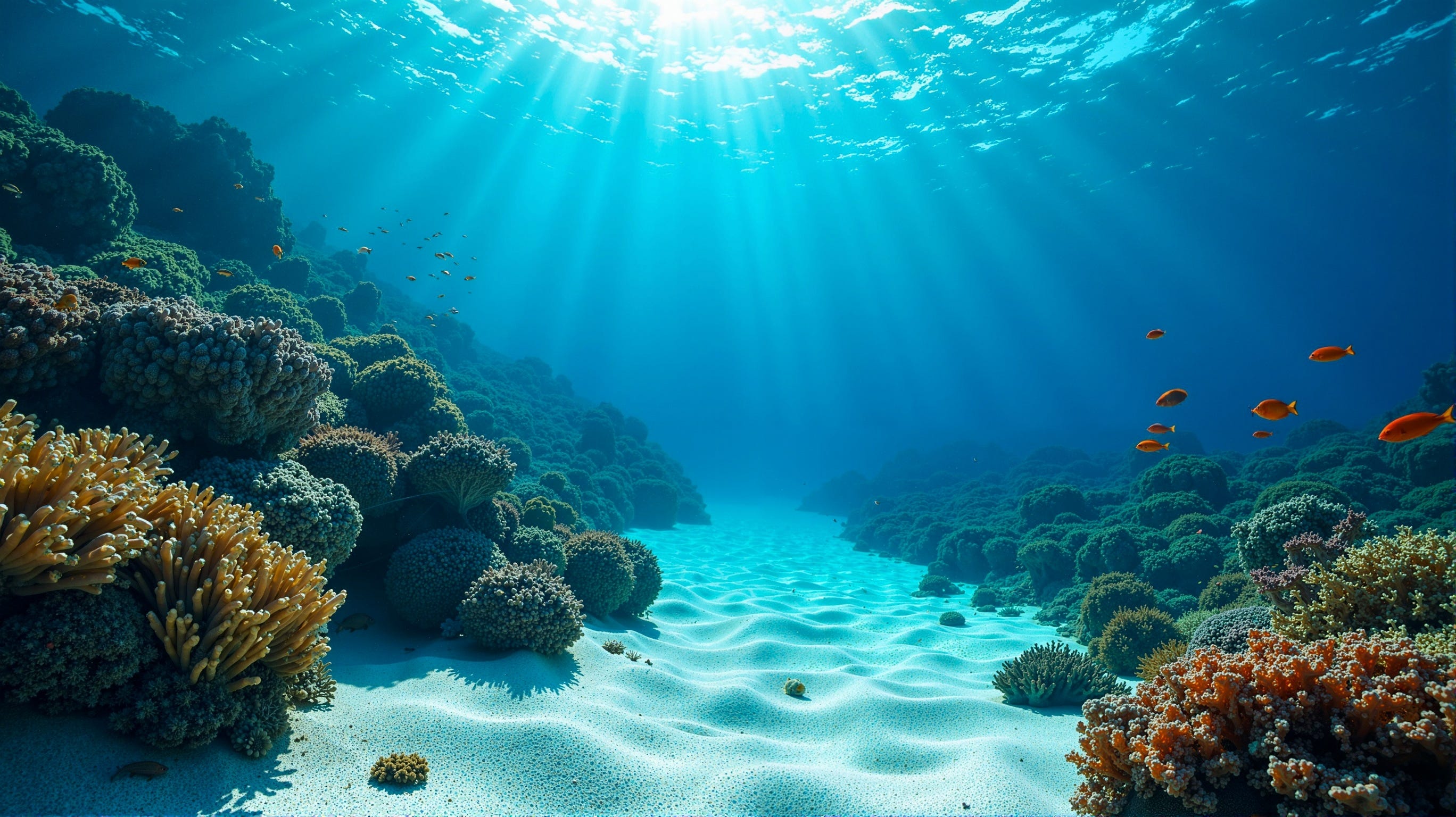
Image Credit: Sergey Nikolaevich/ Shutterstock
#1 – Climate Change: Fire Down Below
The ocean is the Earth’s great thermostat, quietly regulating our climate — but now, it’s overheating. Since 1993, the rate of ocean warming has more than doubled,7 unleashing a cascade of physical and chemical changes: seas are rising as water expands and polar ice melts; ice sheets in Greenland and Antarctica are destabilizing, threatening to reshape coastlines worldwide; hurricanes and typhoons are becoming stronger and wetter as they draw energy from hotter waters; and marine heatwaves, once rare, now strike with alarming frequency, cooking kelp forests, bleaching coral reefs, and disrupting fisheries. These shifts reverberate through ecosystems and economies alike — from coastal communities facing erosion and flooding, to global food systems strained by collapsing fisheries.
Climate change also drives ocean acidification, which weakens corals’ ability to build reefs. The Great Barrier Reef has already lost more than 50% of its coral cover in recent decades.8 Caribbean reefs have seen similar losses, and scientists warn that by mid-century most tropical reefs will be impacted. As reefs erode, the consequences ripple outward: fish lose their nurseries, coastlines lose a natural barrier, and entire reef-based economies — an estimated $375 billion per year9 — begin to collapse. Acidification extends beyond coral: oyster hatcheries in the Pacific Northwest have experienced mass die-offs as larvae fail to form shells, while microscopic plankton, the foundation of the marine food web, are similarly vulnerable.
#2 – Pollution: The Toxic Tide
Our oceans are drowning in our waste. Pollution is an assault on the ocean’s ability to sustain life. Every minute, the equivalent of a garbage truck of plastic is dumped into the sea — more than 8 million metric tons each year. As much as 80% of all litter in our oceans is made of plastic.10 Much of it breaks down into microplastics smaller than a grain of rice. These insidious particles infiltrate plankton, accumulate in fish guts, and travel up the food chain into humans. A recent study detected microplastics in 99% of seafood samples,11 and another found them in human placentas. Left unchecked, plastic pollution entering the ocean is projected to nearly triple by 2040.12
Runoff from farms, rich in nitrogen and phosphorus, adds to the pain, fueling algal blooms that strip oxygen from the water. This creates hundreds of ‘dead zones’ worldwide, where little to no marine life can survive. The Gulf of Mexico dead zone alone regularly grows to over 6,000 square miles — larger than the state of Connecticut — devastating local shrimp and fishing industries.13 Oil spills, pharmaceuticals, heavy metals, and untreated sewage further compound the chemical burden, while noise pollution from shipping, seismic testing, and naval sonar interferes with whales and dolphins, disrupting migration, hunting, and communication.
#3 – Overfishing: From Plenty to Empty
Wild fish stocks around the globe are being driven toward collapse. Nearly 40% of global fish stocks were being fished at biologically unsustainable levels — compared to just 10% in 1974.14 The pattern repeats across the world’s oceans. Industrial fishing has become extraordinarily efficient at finding and catching fish, but this efficiency is exhausting ocean life faster than it can replenish itself.
The methods are brutal. Bottom trawling — dragging weighted nets across the seafloor — is the marine equivalent of clear-cutting forests. Corals, sponges, and other organisms that took centuries to grow are scraped away in minutes, leaving behind barren underwater deserts. Each year, bottom trawling disturbs an area of seafloor larger than South America. Longline vessels stretch lines up to 50 miles, baited with thousands of hooks. Both practices are indiscriminate. Billions of fish die this way each year, along with hundreds of thousands of turtles, seabirds, and marine mammals — collateral damage known as ‘bycatch’.
Overfishing doesn’t just deplete fish populations; it undermines the ocean’s capacity to absorb carbon. Fish transport carbon to the deep ocean through their waste, and when they die, their bodies sink to the seafloor — locking that carbon away for centuries or even millennia. Large fish, which live longer and dive deeper, are particularly effective carbon transporters. Industrial fishing fleets preferentially targets these large, long-lived species, removing the ocean’s most effective biological carbon pumps.
The ecological toll is staggering. More than one-third of all sharks, rays, and chimaeras now face extinction. As apex predators, sharks maintain the balance of marine ecosystems, whose removal has a cascading effect. When shark populations decline, prey species surge, devouring vegetation and smaller life forms until ecosystems are fundamentally altered.
#4 – Habitat Destruction: The Wrecking Ball
Even when we’re not fishing, human activity reshapes marine environments. Along coasts, mangroves and salt marshes are cleared for ports, resorts, and seawalls. Anchors from cruise ships crush delicate habitats. Dredging clouds waters with sediment that suffocates coral reefs. More than half of all mangroves — critical ecosystems, bridging land, freshwater, and sea — are at risk of collapse by 2050.15 In shallow waters, destructive fishing methods multiply the damage. Blast fishing (detonating explosives underwater to kill or stun fish) obliterates reefs, while cyanide fishing (spraying sodium cyanide into coral crevices) poisons entire reef systems, killing fish, corals, and the life that depends on them. Both are shockingly common in parts of Southeast Asia.
Deep-sea mining poses yet another threat. Companies are now targeting the ocean floor for rare metals used in batteries and electronics. The deep sea is one of the least understood ecosystems on Earth. Disturbing it risks extinguishing species we have never even discovered. Oil and gas drilling adds further disruption, fragmenting habitats and introducing light, noise, and chemical stress into places that evolved in near-total darkness. These activities don’t just destroy individual species — they unravel entire deep-sea systems that regulate carbon storage, nutrient cycling, and the stability of the ocean itself.
Turning The Tide
These four threats — climate change, pollution, overfishing, and habitat destruction — do not operate in isolation. They amplify one other in ways that make the total impact far greater than the sum of parts. Warming waters worsen pollution impact. Overfished ecosystems lose resilience to climate shocks. Destroyed habitats leave species nowhere to retreat. Yet, just as human activity created the crisis, our initiative can chart a different course. Around the world, solutions are emerging that prove recovery is possible when we act with both urgency and scale.
Marine Protected Areas (MPAs) and Ocean Sanctuaries
When marine reserves are well-enforced, ecosystems rebound. Fish populations multiply, coral cover returns, and biodiversity flourishes. Countries like Palau and Chile have created massive sanctuaries, and global targets call for protecting 30% of the ocean by 2030. Today, only 8% is meaningfully safeguarded — a gap we must urgently close.16
Sustainable Fishing Practices
Some fisheries have shown remarkable recoveries after adopting science-based catch limits. Alaska’s salmon and several U.S. East Coast fisheries prove it can be done. Phasing out bottom trawling, reducing bycatch with improved gear, and prioritizing ecosystem health can transform how the world fishes.
Plastic Reduction and Cleanup
Stopping the tide of plastic requires upstream solutions. Reducing single-use plastics, building better waste systems, and embracing circular economies are crucial steps. Initiatives like The Ocean Cleanup aim to capture plastic before and after it enters the sea.
Coastal Habitat Restoration
Communities worldwide are replanting mangroves, reviving salt marshes, and protecting seagrass beds. These projects boost fisheries, buffer coastlines from storms, capture carbon, and create jobs. Indonesia, which contains approximately 20% of global mangroves, has already seen fish populations rebound through restoration efforts.
Climate Action
Ultimately, the ocean’s fate hinges on cutting greenhouse gas emissions. Transitioning to renewables, protecting forests, and transforming agriculture all reduce the stress on seas. The ocean has bought us time by absorbing heat and carbon — but that buffer is finite. Every degree of avoided warming means less acidification, less bleaching, and more resilience.
Blue Carbon Finance
New financial tools are beginning to value the carbon stored in mangroves, seagrasses, and salt marshes. By monetizing their role as ‘blue carbon’ sinks, conservation becomes competitive with development, offering coastal communities both economic and ecological benefits.
The Ties That Bind
The ocean’s health and humanity’s future are inseparable. If the ocean thrives, so does humanity. It regulates our climate, produces the oxygen we breathe, and feeds billions. But the ocean is not an infinite resource. Climate change, pollution, overfishing, and habitat destruction are converging to push it toward collapse. We are approaching a tipping point where recovery may no longer be possible. If we fail the ocean, we fail ourselves. If we protect it, we secure our own future.
NOAA Ocean Service. Ocean Facts (2023). How much water is in the ocean?
NIH (2021). Nourishing nations during pandemics.
NOAA (2024). How much oxygen comes from the ocean?
Frontiers in Marine Science (2023). Marine biodiversity discovery: the metrics of new species descriptions.
NOAA (2021). 4 Ways NOAA is Studying the Ocean’s Role in Climate.
ScienceAlert (2020). Since 1995, We’ve Lost More Than 50% of Great Barrier Reef Corals.
UNEP (2018). Coral reefs: We continue to take more than we give.
UN Ocean Conference (2017). Factsheet: Marine pollution.
The Guardian (2025). Study finds microplastic contamination in 99% of seafood samples.
FAO (2022). The State of World Fisheries and Aquaculture.