
The 8 Differences Between Tech & Biotech Startups
“There are many paths to the top of the mountain, but the view is always the same.”
— Chinese Proverb
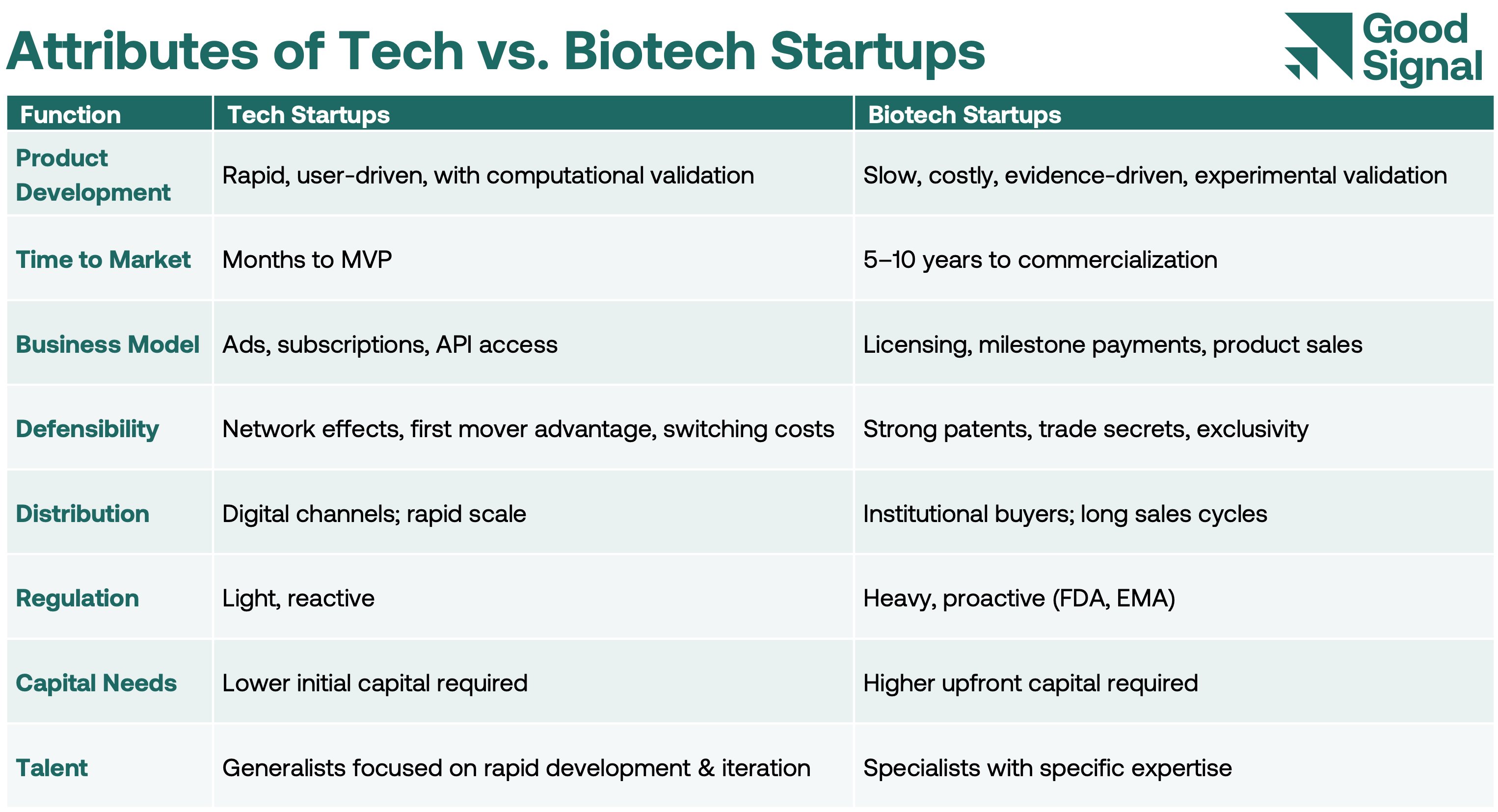
The word startup evokes both mystique and admiration — brilliant founders, breakthrough products, and blockbuster IPOs. Beneath the glamour, however, the journey is grueling and unpredictable. Success is extraordinarily rare. Whatever the outcome, not all startups follow the same path. While startups in both technology (e.g. software applications, hardware devices, artificial intelligence, internet-based solutions) and biotechnology (e.g. drug discovery, genetic engineering, agricultural biotech, precision fermentation) have the potential for transformative impact, their playbooks, pace, and pitfalls are radically different. Here are eight dimensions where tech and biotech startups diverge — and why it matters.
(1) Product Development: Modular vs. Sequential
Tech startups thrive on rapid iteration. Feedback is immediate, failures are learning opportunities, and the cost of switching direction is low. Code can be refined quickly without requiring significant time or resources. Instant computational validation, rapid bug fixes and automated test cycles, A/B experiments and continuous deployment of new features all accelerate feedback loops and improve product quality.
Biotech startups, by contrast, operate with much slower feedback loops. Developing a viable strain involves a lengthy process of shortlisting, editing, and refining candidates before moving to wet lab experiments. From there, scaling up must be done carefully to avoid performance deterioration. A change midway through this process can mean starting over entirely, potentially setting a team back months or even years. In biotech, each decision builds on the previous one, resulting in high switching costs and compounding complexity.
(2) Time to Market: Sprint vs. Marathon
At a tech startup, an MVP (Minimum Viable Product) can ship in weeks or months, with user feedback driving near-daily refinements. Launching early — even with bugs — is embraced, even encouraged. When mistakes happen, they can be fixed quickly, with updates rolled out seamlessly across the entire system. “Move fast and break things” isn’t just a motto; it’s a strategy.
Biotech startups play a much longer game. Product development involves complex R&D, rigorous clinical trials, and regulatory hurdles. A successful launch can take 5 to 10 years — if things go well. There’s no room to “break things” when human health is on the line. The stakes are higher, and so is the cost of failure.
(3) Business Model: Incremental Revenue vs. Big Bets
Tech companies enjoy flexibility in monetization — from freemium SaaS to subscription platforms, ads, or transactional models. Revenue can begin flowing shortly after product-market fit, and companies often pivot to new models as they scale or see new opportunities.
Biotech startups live with much greater uncertainty. Revenue comes after years of effort — and it often hinges on regulatory approval. Commercialization typically comes through product sales, licensing, or milestone payments from food and pharma industry partners. There’s no pivoting mid-trial if the science doesn’t pan out.
(4) Defensibility: Platforms vs. Patents
In tech, defensibility usually comes from scale and speed — network effects, brand loyalty, switching costs, or first-mover advantage. Software patents are difficult to enforce, and the market often rewards execution over legal protection. Proprietary datasets give tech companies defensibility by powering personalization, creating customer lock-in and fueling superior machine learning capabilities.
In biotech, patents, exclusive licenses, and trade secrets are the moat. Without robust intellectual property protection, it’s difficult to attract investment or deter competition. The path to value creation runs through the patent office. Extensive patent portfolios and licensing agreements are crucial for long-term value.

Image Credit: Thitichaya Yajampa; Panuwatccn
(5) Distribution: Blitzscaling vs. The Long Game
Tech startups can scale distribution at breakneck speed — via app stores, viral growth, or direct digital sales. A clever user interface, growth hack, or successful launch campaign can create global adoption in months. Distribution channels — access to online platforms, organic or paid user acquisition, or product integrations — are digital, direct, and have minimal friction. Because distribution is digital, startups can iterate rapidly based on user data, test messaging in real time, and optimize acquisition loops continuously.
In biotech, the opposite is true. Bringing a new drug to market requires navigating a complex ecosystem that includes federal regulatory bodies, clinical trial networks, hospital systems, academic research centers, and insurance players who ultimately influence access and reimbursement. For biotech startups focused on food or ingredient production, the path involves engagement with food safety and regulatory authorities, partnerships with contract manufacturers and co-packers, and compliance with local and state health departments to ensure safe distribution and sale. Lead generation in biotech is almost purely relationship-driven. Sales cycles can take several years and must start before the technology is even fully validated. Viral marketing only captures a small subset of the customer base.
(6) Regulatory Climate: Reactive vs. Proactive
Tech companies face limited regulatory friction, at least initially. While issues such as data privacy, intellectual property, or cybersecurity are increasingly important, most tech ventures can launch products into the market with relative ease. Compliance comes later, often only after significant scale — in areas like privacy (GDPR, CCPA), payments (FINRA), or ethics — and is often reactive based upon response from the market or regulatory agencies.
Biotech startups operate in a highly regulated environment. Product development is subject to rigorous scrutiny by government agencies such as the U.S. Food and Drug Administration (FDA), the European Medicines Agency (EMA), or their counterparts worldwide. Each phase of product development must meet strict safety and efficacy standards, with detailed documentation and extended review periods. Non-compliance can result in severe penalties, product recalls, or even company shutdowns.
(7) Capital Requirements: Phased vs Front-Loaded
A modern tech startup can launch with minimal capital thanks to cloud computing, open-source frameworks, and no-code tools. As tech companies scale, multiple data points are available from monitoring product development to market feedback, and the capital required is relatively lower compared to biotech startups. Funding can be incremental, with new rounds raised as the company hits growth targets or expands its user base.
Biotech startups, on the other hand, are capital intensive from the outset. Laboratory infrastructure, specialized equipment, highly educated personnel, and the costs of conducting clinical trials demand significant early investment. Biotech entrepreneurs typically seek substantial seed funding, often from grants, angel investors, or specialized venture capital firms with experience in the life sciences. Government support and partnerships with universities and incumbents are also common and oftentimes required. Returns for investors are typically realized over much longer horizons due to the lengthy R&D process.
(8) Talent: Generalists vs Specialists
In a tech startup, particularly in software, the team is often comprised of generalists who can move fast, wear multiple hats, and ship code. Engineers, designers, and growth hackers are recruited early, prized for their ability to launch, learn, and scale quickly without deep domain specialization. Hiring cycles are shorter, compensation typically includes meaningful equity, and the bar is less about pedigree and more about hustle and output. For most tech startups, product-market fit is the focus, not deep R&D.
Biotech startups, in contrast, require deep technical expertise and domain-specific specialization from the start. Early hires are typically scientists with advanced degrees, regulatory experts, lab operations staff, and clinical researchers — individuals who contribute to experimental design, wet lab work, and milestone-driven R&D. A biotech startup must integrate expertise across biology, chemistry, manufacturing and data science, requiring a deliberate, focused hiring strategy. Teams must build defensible IP, navigate complex regulatory pathways and scale up production.
Charting The Future
While both tech and biotech startups drive innovation and economic growth, their paths diverge in significant ways. Tech startups thrive on speed, flexibility, and lower entry barriers, while biotech startups navigate scientific uncertainty, heavy regulation, and high capital requirements. Understanding these differences is vital for entrepreneurs choosing their journey, for investors considering where to place their bets, and for policymakers shaping the environments that enable innovation.
The advent of artificial intelligence will no doubt shift norms and best practices, as we are already seeing with a shift to leaner teams, utilization of vast and complex datasets, large infrastructure deployments, protein engineering, and in silico modeling. One thing is clear: innovation is accelerating, and tech and biotech are set to shape our future — each on its own extraordinary path.
This article was inspired by a longer piece written by Mark van Zee titled “Biotechnology versus Technology Companies”. We thank him for sharing his insights with us.